
One API or Many? How Failover Keeps Your Recharge Success Rate High
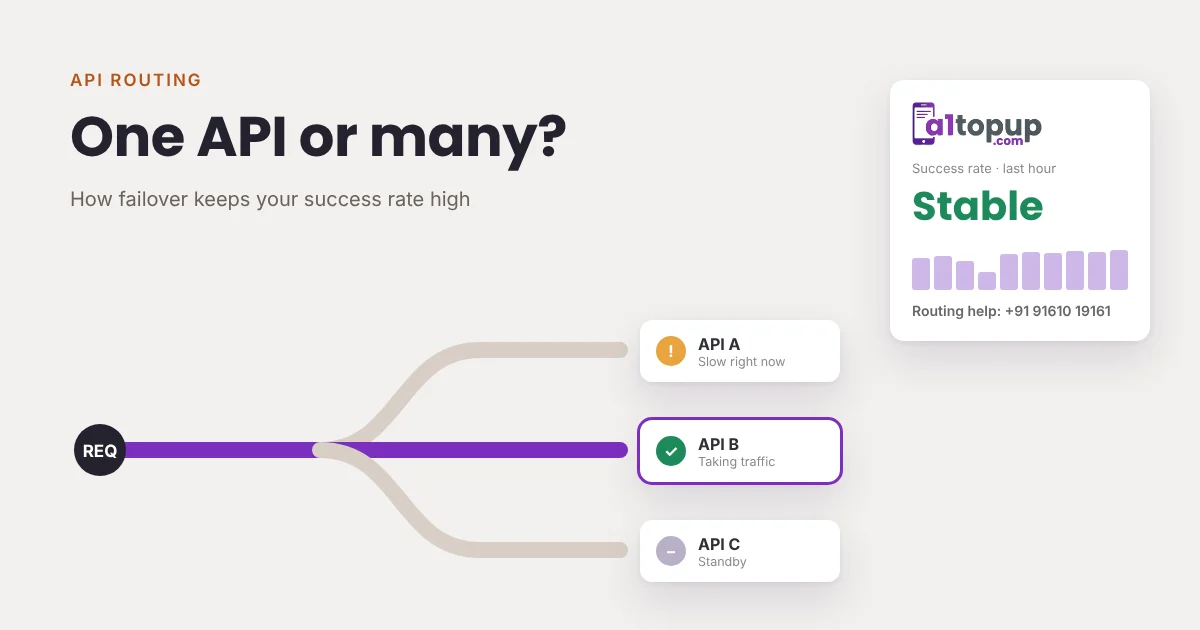
Every recharge API has bad hours: an operator system is slow, a server is under maintenance, or a sudden rush builds up pending transactions. If your platform depends on one API, those hours hit every retailer at once. That is when retailers start trying another app.
The answer most growing platforms use is simple: connect more than one API and route traffic between them.
Three ways to use more than one API
| Method | How it works | Good for |
|---|---|---|
| Operator-wise routing | Jio goes to API A, Airtel to API B, based on who is better for each | Getting the best success rate and margin per operator |
| Manual switch | Admin changes the API for an operator from the panel when one is slow | Small networks; simple and safe |
| Automatic failover | If API A fails or is down, the next request goes to API B | Larger networks with steady volume |
The rule that matters most
Never send a pending recharge to a second API. A pending recharge may still succeed on the first API. If you resend it, the customer may get two recharges and you pay twice. Failover should apply to new requests, or only to requests that came back as a clear failure.
Pro tip: keep a small balance with your backup API all the time. Failover is useless if the backup wallet is empty on the day you need it.
What your software needs
- An API list in the admin panel, with an on/off switch per operator
- Success rate per API and per operator, for today and the last hour
- Clear rules for which failure messages allow a retry on another API
- A separate balance view for each API wallet
- Reports showing which API handled each transaction, for reconciliation
Choosing a backup API
Use the same checks you would for your main provider: live operators, success rate, settlement speed for pending, callback support and support hours. Our 10 demo questions work for API providers too, and the operator codes and common errors guide helps you map error messages.
Is one API ever enough?
For a small network starting out, one reliable API with good support is fine. Once your retailers depend on you every day, a backup API is cheap insurance.
Set up routing on your platform
A1Topup's recharge software supports multiple APIs with operator-wise switching, and our recharge API can work as your main or backup route. Ask us on WhatsApp.
Frequently asked questions
Why use more than one recharge API?
Can I resend a pending recharge to another API?
What is operator-wise routing?
Have a question? Talk to our team
Related articles
DTH Recharge API: Operators, Customer ID Checks and Common Failures
DTH recharges fail for different reasons than mobile. How to check customer IDs, handle pending status and cut failed DTH recharges.
Read more →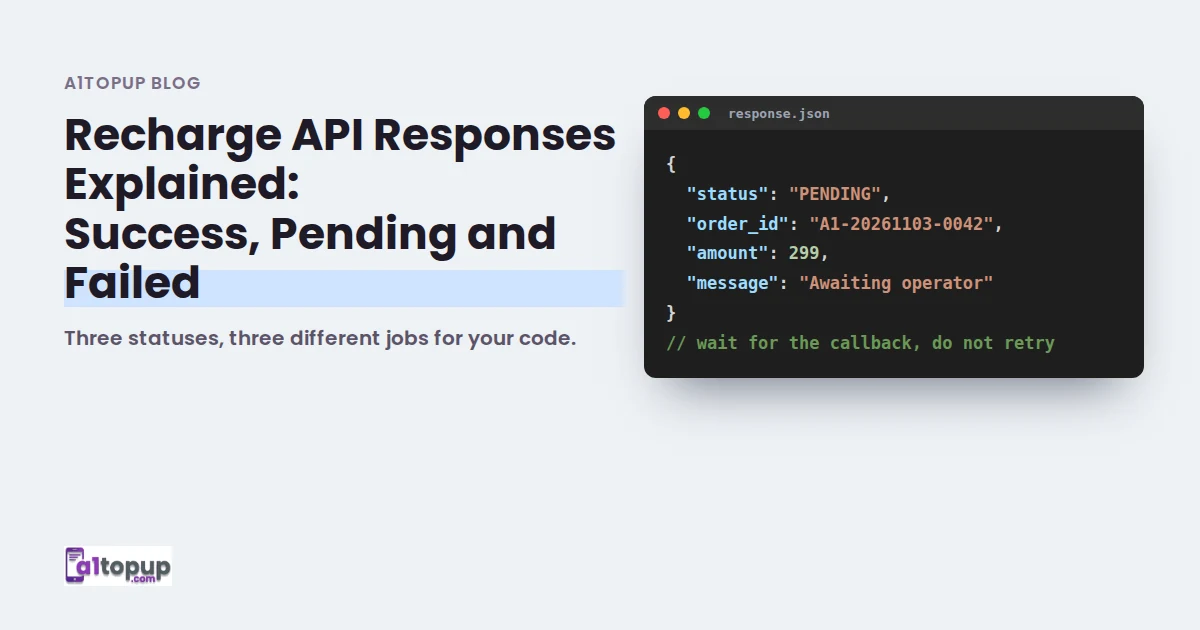
Recharge API Responses Explained: Success, Pending and Failed
Three statuses, three different jobs for your code. Here is how to handle each one safely.
Read more →
Recharge API Integration Security Checklist for Developers
Recharge APIs move real money. Ten checks to run before your integration goes live.
Read more →