
How to Choose a Recharge API Provider: 10-Point Checklist (2026)
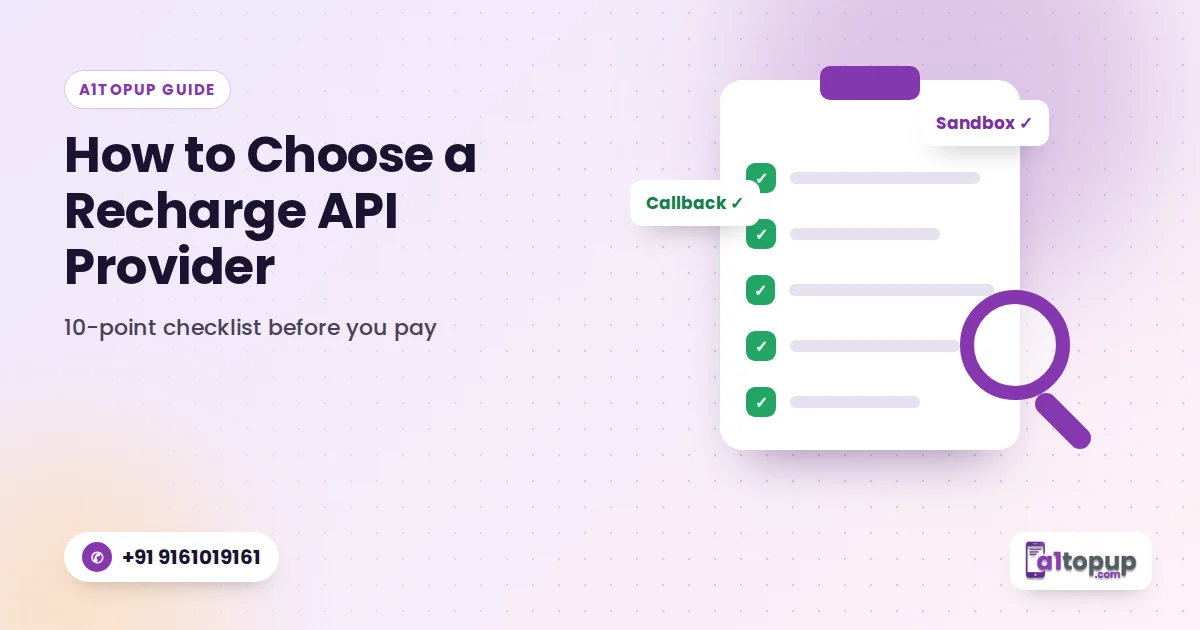
Key takeaways
- Test success rate and speed yourself with small live recharges
- Compare the full operator-wise commission list, not one number
- Insist on callbacks, clear docs and a sandbox before paying
A recharge API is the engine of your recharge business. When it is slow or unreliable, your retailers lose customers and you lose money on pending and failed recharges. This checklist helps you compare any recharge API provider before you pay, including us.
1. Direct operator connectivity
Ask how the provider connects to Jio, Airtel, Vi and BSNL. Every extra hop between you and the operator adds delay and another point of failure. Direct or near-direct connectivity usually means faster recharges and fewer pending cases.
2. Real success rate and uptime
Every provider claims a high success rate. Ask for numbers from the last few weeks, and test with real recharges of small amounts. A sandbox test proves the integration works; a few live recharges prove the speed.
Call the support number before you buy. How fast they answer now is how fast they will answer when a recharge is stuck.
3. Transparent, operator-wise commission
You should see commission for each operator and service in writing, plus the plan fee and any other charges. Be careful with offers that only quote the highest commission of one operator. Compare the full list, like our recharge API commission list.
4. Callback (webhook) support
Some recharges stay pending for a few seconds or minutes. A callback URL lets the provider tell your system the final status automatically, so you never have to guess whether to refund a customer.
5. Clear documentation and a sandbox
Good documentation lists every parameter, sample request, sample response and error code. Look at the API documentation before you buy. If a developer cannot understand it in an hour, integration will take much longer.
6. Wallet top-up and settlement
- How fast is your wallet credited after you pay?
- Can you download a ledger and match it with your own records?
- What happens to the amount of a failed recharge?
7. Extra APIs you will need later
Most recharge platforms grow into DTH, bill payments and FASTag. Plan and operator APIs also help: the recharge plan API shows live plans, and the operator detection API picks the right operator from a mobile number, which reduces wrong recharges.
8. Support that actually answers
Call the support number before you buy. Check whether you can reach a person on phone and WhatsApp during business hours, and how disputes and complaints are handled.
9. A registered, established company
Check the GST number, the company registration and how long the provider has been in business. A1Topup is a registered company working in recharge since 2016.
10. A clear upgrade path
If you plan to add retailers and distributors, ask whether the same provider offers white label recharge software with the API already inside. Moving later is costly.
Quick comparison table
| Check | What a good answer looks like |
|---|---|
| Connectivity | Direct or near-direct to operators |
| Commission | Written, operator-wise list |
| Callbacks | Automatic final status to your URL |
| Docs | Samples, error codes, sandbox |
| Support | Phone and WhatsApp, quick replies |
Questions to ask on the sales call
- Which operators and services are live today, and which are "coming soon"?
- What was your success rate last week for Jio, Airtel, Vi and BSNL?
- How long does a pending recharge usually take to settle?
- How are failed amounts returned, and how quickly?
- Is there a limit on transactions per second or per day?
- Who do I call when something fails at night or on a Sunday?
Write the answers down. A provider who answers clearly before you pay usually supports you well after you pay.
Red flags to avoid
- Very high commission on every operator that looks too good to be true
- No sandbox or test credentials before payment
- No written commission list or plan terms
- Only one contact number that nobody picks up
- Pressure to pay immediately for a "today only" offer
How to test a provider in one day
- Get sandbox credentials and run every request in the documentation.
- Check that the callback reaches your server with the final status.
- Do five small live recharges on different operators at different times.
- Raise one test complaint and see how fast support replies.
This single day of testing tells you more than any brochure.
Conclusion
Pick the provider that passes this checklist, not the one with the biggest single commission number. If you want to test ours, get API access or book a free demo.
Want to test our recharge API?
Get sandbox access and see the operator-wise commission.
Frequently asked questions
What is the most important thing in a recharge API provider?
Do I need a developer for a recharge API?
How do I compare commission between providers?
Have a question? Talk to our team
Related articles
DTH Recharge API: Operators, Customer Info and Common Errors
DTH customers come back every month. Here is how the API side works and what usually goes wrong.
Read more →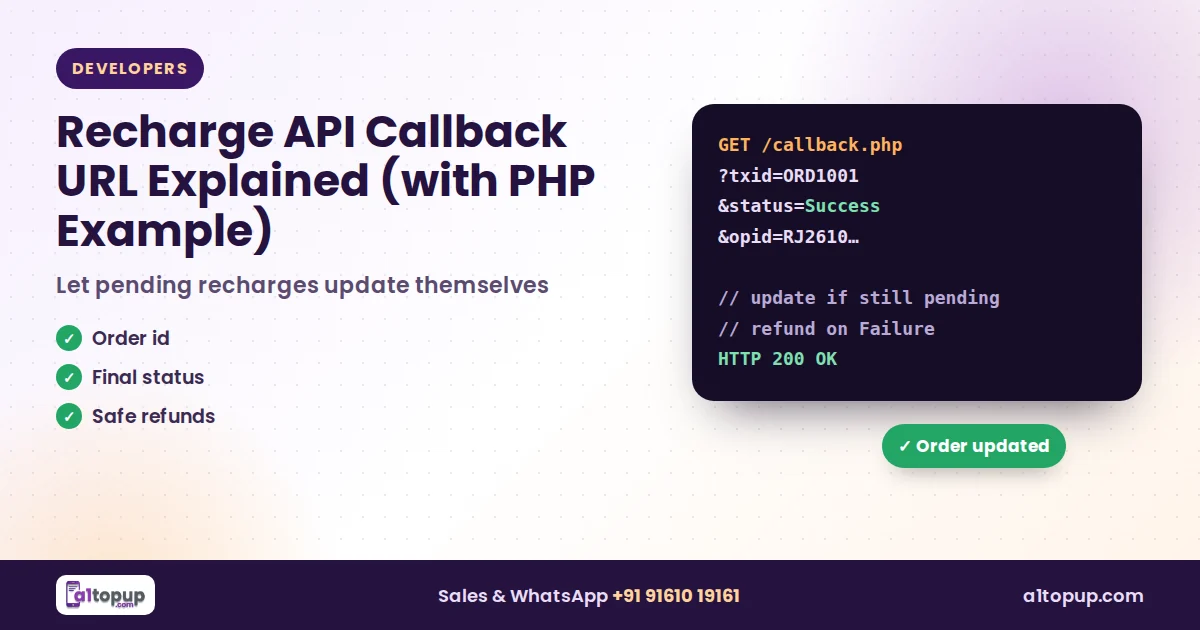
Recharge API Callback URL Explained (with PHP Example)
Pending recharges update themselves when your callback URL is set up right. Here is how it works, with a PHP example.
Read more →
How to Start a Recharge API Business and Become an API Provider
Sell recharge API access under your own brand: what you need, how pricing works and how to find your first API clients.
Read more →